Policy & Justice
School Sexual Violence Policies: Require Access & Awareness
RAINN urges state lawmakers to require schools to proactively share sexual violence policies, reporting options, and supportive measures with students, parents, and staff.
Sexual violence happens in schools. In that moment of crisis, survivors do not know what to do. Unfortunately, school policies and any potential resources are hidden deeply in websites, buried in handbooks, or a distant memory of an orientation years in the past.
In one case, RAINN spent over 30 minutes looking for a public K-12 school’s sexual violence policy, only to find it on a webpage titled, “Jobs”. For a student, friend, parent, teacher, or staff member seeking information in a moment of crisis, such inaccessibility and deprioritization of information is unacceptable.
Survivors on school campuses nationwide know that the resources and policies schools put in place for survivors of sexual violence do not reach the people they are intended to serve. While schools maintain sexual violence policies and may have procedures in place to support a student experiencing the aftermath of an assault, these resources are often difficult to access and understand.
State lawmakers must pass laws to ensure this vital information reaches students, parents, faculty, staff, and leadership so that everyone knows what to do in the case of sexual violence.
Schools Can Help Survivors Start Healing & Keep Learning
Sexual violence remains a pervasive issue in K-20 educational institutions.
Among undergraduate students, 26.4% of females and 6.8% of males experience rape or sexual assault through physical force, violence, or incapacitation. (1)
Meanwhile, 21% of middle schoolers reported that they experienced unwanted physical touching on school grounds. (2)
Unfortunately, many schools fail to notify their students of:
- The process for reporting sexual violence
- What will happen if they choose to report
- How to access resources
Only one-third of students felt “very knowledgeable” about where to get help and how to report sexual violence. (3) Similarly, only 17.7% of students were aware of what occurs after an incident is reported. (4) Without knowing what happens or how to report, survivors and witnesses may not report the assault, leaving the perpetrator to get away with no accountability and harm again.
How Sexual Violence Impacts Students’ Success
The impact of sexual violence on academic success can be severe. Students who experience sexual assault are more likely to:
- Earn lower GPAs
- Struggle with emotional self-regulation
- Drop out of school altogether
The university dropout rate is approximately 14.4% higher for students who experience sexual victimization compared to the average. Similarly, 14.3% of women who experienced sexual violence in their first semester of college ended the semester with a GPA below 2.5. (5)
Transparent sexual violence policies support the academic and emotional well-being of student survivors and their peers.
Students and staff need to know what to do about a sexual assault before it happens. Just like they run a fire drill to know what to do in a crisis, knowing where to go and who to go to ahead of time makes it more likely they will be able to access those resources when they are in the middle of the trauma of sexual violence.
Schools Must Clearly & Proactively Communicate Sexual Violence Policies
A dangerous gap exists between the policies and resources schools have for cases of sexual violence and the survivors of sexual violence who need them. States can close this gap by requiring educational institutions to create accessible, transparent sexual violence policies that outline the resources available and how to report sexual violence.
As shown below, no state statute effectively and comprehensively requires educational institutions to proactively notify students, staff, and families about sexual violence policies. In fact, even the states that address school sexual assault policies in their statutes fall severely short of attaining true transparency, clarity, and accessibility.
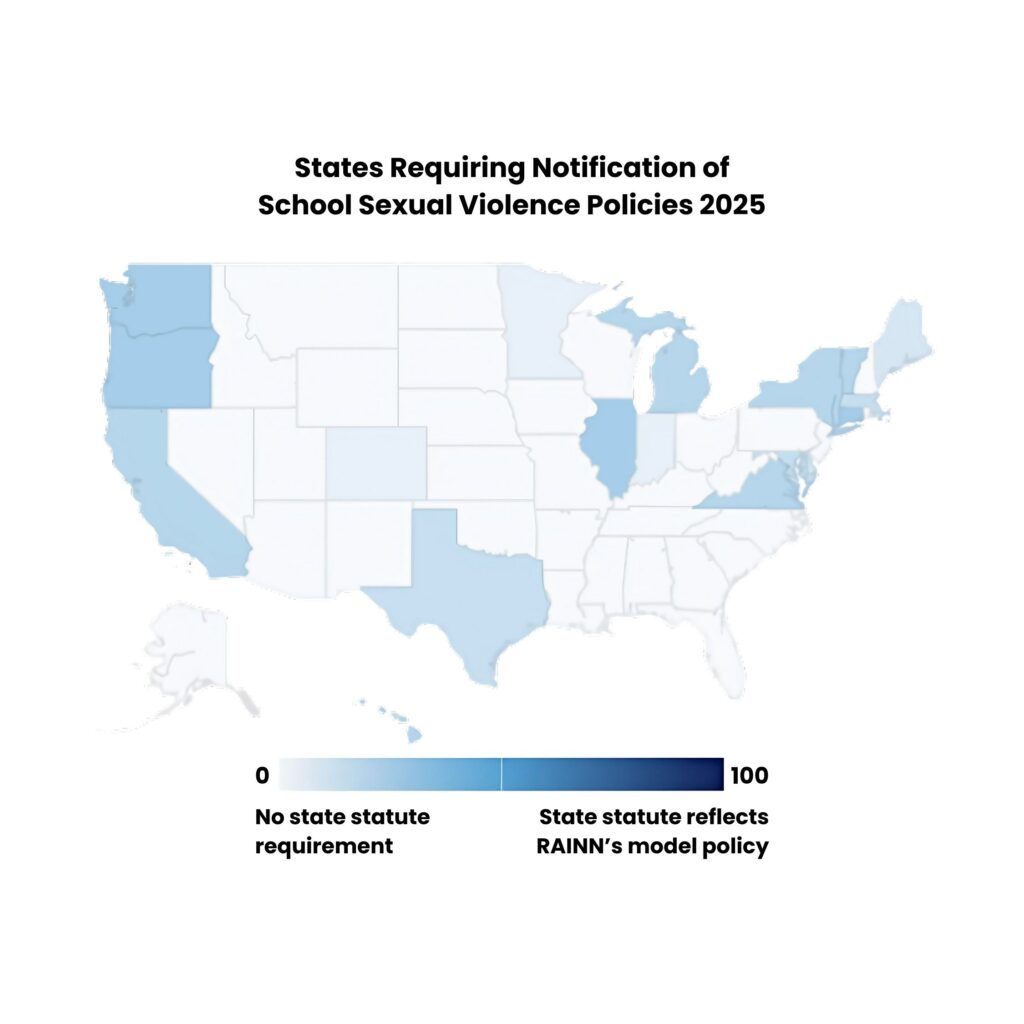
Lawmakers can ensure that no student’s education has to suffer because they experience sexual violence by requiring public and private K-20 educational institutions to notify students and parents of their sexual violence policies.
States must ensure that these policies are communicated clearly and understandably, and made accessible via both annual dissemination and multiple frequently used communication channels (such as websites, handbooks, and community spaces).
It’s time for lawmakers to tell schools to prioritize communicating sexual violence policies proactively and clearly.

For Legislators: Example Legislation
RAINN’s policy memos and issue briefs help lawmakers draft bills that promote justice for survivors and hold perpetrators accountable.
Work With Us
We recognize that each state’s code is unique and complicated. RAINN’s policy team can work hand in hand with lawmakers and their staff to tailor these recommendations to each state’s specific needs.

Contact RAINN’s Policy Team
RAINN works with lawmakers across the country to advance bipartisan legislation that prevents sexual violence, improves justice, and holds perpetrators accountable.
NOTES & CITATIONS
(1) Cantor, D., Fisher, B., Chibnall, S., Townsend, R., et al. “Report on the AAU Campus Climate Survey on Sexual Assault and Sexual Misconduct.” Association of American Universities, January 17, 2020
(2) Rinehart, S., Doshi, N., Espelage, D. “Sexual Harassment and Sexual Violence Experiences Among Middle School Youth.” University of Illinois at Urbana-Champaign, April 6, 2014.
(3) Cantor, D., Fisher, B., Chibnall, S., Townsend, R., et al. “Report on the AAU Campus Climate Survey on Sexual Assault and Sexual Misconduct.” Association of American Universities, January 17, 2020
(4) Ibid.
(5) Jordan, C., Combs, J., Smith, G., “An Exploration of Sexual Victimization and Academic Performance Among College Women.” University of Kentucky, Office for Policy Studies on Violence Against Women, July 2014.
Last updated: July 26, 2026