Federal Legislation
We work tirelessly to help Congress pass meaningful anti-sexual violence laws. See the RAINN-endorsed federal laws promoting prevention, justice, and healing.
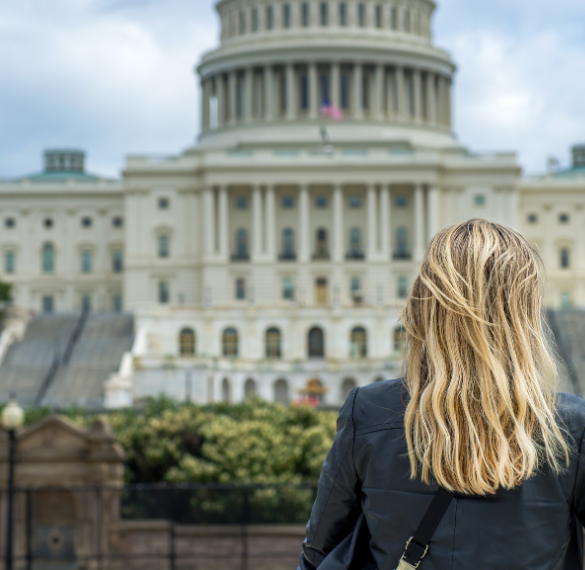
Our bipartisan partnerships with U.S. lawmakers help create, advance, and pass legislation that strengthens protections for survivors and holds offenders accountable.
Federal Legislative Wins
RAINN advised on, co-created, and/or lobbied for these federal bills that successfully advanced through Congress and were signed into law:
PROTECT Our Children Act – 2025 reauthorization
In December 2025, Congress reauthorized the PROTECT Our Children Act through the FY2026 National Defense Authorization Act, strengthening the federal response to online child sexual exploitation.
Epstein Files Transparency Act
In November 2025, the Epstein Files Transparency Act became law, advancing transparency by requiring the Department of Justice to release records related to Jeffrey Epstein.
TAKE IT DOWN Act
In May 2025, the TAKE IT DOWN Act became law, strengthening accountability for nonconsensual intimate images, including AI-generated deepfakes, and requiring covered platforms to remove reported content.
Victims’ VOICES Act
In July 2024, Congress passed the Victims’ VOICES Act, strengthening financial accountability for people convicted of federal crimes.
This law ensures that survivors’ families and advocates can receive restitution for costs incurred while supporting the survivor, enabling “restitution for expenses of persons who have assumed the victim’s rights.” This means a convicted offender must reimburse those who help the survivor obtain services or attend court.
For example, parents of child survivors often miss work and pay out-of-pocket for counseling and travel. Thanks to this act, they can be repaid for these expenses.
Debbie Smith Act – 2024 reauthorization
In July 2024, Congress reauthorized the Debbie Smith Act, helping sustain federal support to test DNA evidence, reduce backlogs, and improve access to justice.
Twenty years after its inception, President Biden, who cosponsored the original bill in 2004, signed this reauthorization into law and extended the Debbie Smith DNA Backlog Grant Program through FY2029.
This program funds state and local crime labs to test DNA evidence, including sexual assault kits, at up to $151 million per year.
Project Safe Childhood – 2024 reauthorization
In December 2024, Congress modernized and reauthorized Project Safe Childhood through the FY2025 National Defense Authorization Act.
This law’s provisions included:
- Improved investigations. Project Safe Childhood provides law enforcement with new resources and training to investigate internet crimes against children and to rescue children who are being abused online.
- Expanded prosecution resources. It mandates that the U.S. Attorney General develop best practices for prioritizing online exploitation cases and funds additional prosecutors dedicated to child exploitation cases.
Jenna Quinn Law
In December 2024, Congress passed the Jenna Quinn Law, expanding prevention education and training to help adults recognize and report child sexual abuse.
Stop Institutional Child Abuse Act (SICCA)
In December 2024, Congress passed the Stop Institutional Child Abuse Act, creating a federal path toward greater transparency, oversight, and safety in youth residential programs.
The Stop Institutional Child Abuse Act was a bipartisan breakthrough to protect youth in residential treatment programs (such as “troubled teen” facilities). Signed into law in late 2024, this act will transform how residential youth programs are run and managed. The law’s provisions included:
- Transparency. This act establishes a federal working group to set best practices, improve data transparency (including a possible national database on youth treatment facilities), and study abusive practices like improper restraints.
- Accountability. The Stop Institutional Child Abuse Act requires the government to collect data and report on treatment facilities, exposing patterns of abuse and preventing future neglect or mistreatment of kids in these programs.
REPORT Act
In May 2024, Congress passed the REPORT Act, strengthening requirements for online platforms to report child sexual exploitation and preserve evidence for law enforcement.
The Revising Existing Procedures On Reporting via Technology (REPORT) Act strengthens online protections for children, motivating platforms to take child sexual abuse material seriously and helping to rescue kids from harm more quickly. This law’s provisions included:
- Reporting requirements. The REPORT Act ensures tech platforms alert law enforcement about online child abuse, so child survivors can be identified and helped faster.
- Impactful penalties. The REPORT Act increases penalties (up to $1 million) for companies that don’t report sexual exploitation, incentivizing them to prioritize child safety and prevent future victimization.
Trafficking Victims Prevention and Protection Reauthorization Act of 2022
In January 2023, Congress renewed and expanded critical federal efforts to prevent human trafficking and support survivors by passing the Frederick Douglass Trafficking Victims Prevention and Protection Reauthorization Act. This law builds on decades of bipartisan work with provisions that included:
- Renewed funding. The reauthorization invests in prevention and survivor services by funding programs that educate youth, support housing and trauma recovery for survivors, and provide grants to state and local organizations tackling trafficking in their communities.
- Resources and training. Supports law enforcement and prosecution by improving data collection, enhancing anti-trafficking task forces, and expanding training for law enforcement to better identify and support victims.
- International action. Advances U.S. leadership on human trafficking by supporting international anti-trafficking programs and maintaining the annual Trafficking in Persons (TIP) Report to hold countries accountable for protecting human rights.
Abolish Trafficking Reauthorization Act of 2022
In January 2023, Congress passed the Abolish Trafficking Reauthorization Act of 2022, extending federal programs that support survivors of trafficking and strengthen the response to exploitation.
The reauthorization renewed the act’s funding and added these provisions:
- Expanded services for at-risk youth. It funds state and community programs that support young people vulnerable to trafficking—especially those transitioning out of foster care or experiencing homelessness, substance use, or abuse.
- Increased federal accountability. It requires anti-trafficking training for all federal employees, demands the monitoring of government supply chains for forced labor, and improves access to mental health and substance use services for survivors.
Violence Against Women Act (VAWA) – 2022 reauthorization
In March 2022, Congress reauthorized the Violence Against Women Act through the Consolidated Appropriations Act, strengthening federal programs that support survivors of domestic violence, dating violence, sexual assault, and stalking.
The 2022 renewal continued this life-saving law’s legacy for the modern era. The VAWA reauthorization’s provisions included:
- Expanded assistance. It preserved and expanded core VAWA programs that support survivors of domestic violence, sexual assault, dating violence, and stalking.
- Increased access. This reauthorization bolstered funding for shelters, rape crisis centers, and legal assistance, and updated provisions to close gaps in access to services for survivors.
Debbie Smith Act – 2014 reauthorization
In September 2014, Congress reauthorized the Debbie Smith Act, extending federal support for DNA evidence testing, forensic exam programs, and efforts to reduce DNA backlogs.
This reauthorization maintained funding levels (authorized at $151 million annually) for the DNA Backlog Grant Program through 2019. New provisions included:
- Greater transparency and efficiency. The 2014 updates incorporated the SAFER Act provisions, requiring local agencies to develop clear plans to reduce their backlogs and publicly disclose the number of untested kits.
Campus Sexual Violence Elimination Act (SaVE)
In March 2014, the Campus Sexual Violence Elimination Act was enacted as part of Congress’ 2013 passing of the Violence Against Women Reauthorization Act, strengthening campus reporting, prevention, and response requirements for sexual violence, dating violence, domestic violence, and stalking.
SAFER Act (Sexual Assault Forensic Evidence Reporting Act)
As part of VAWA’s March 2013 reauthorization, Congress passed the SAFER Act (Sexual Assault Forensic Evidence Reporting Act), helping states and communities audit and address backlogs of untested sexual assault kits. This act’s provisions included:
- Transparency and accountability. It requires law enforcement agencies to audit and publicly report the number of untested sexual assault kits in their possession, confronting the “hidden backlog” head-on.
- Funding reallocation. SAFER ensures that at least 75% of Debbie Smith Act grants go directly toward testing kits and increasing lab capacity (rather than administrative overhead).
Violence Against Women Act – 2013 reauthorization
In March 2013, Congress reauthorized the Violence Against Women Act, strengthening federal responses to domestic violence, dating violence, sexual assault, and stalking.
The bipartisan VAWA Reauthorization of 2013 “strengthens [VAWA] with increased protections for Native American women and other victims previously left vulnerable by gaps in the law.” Notably, VAWA 2013’s provisions included:
- Justice on tribal lands. VAWA 2013 closed a loophole that had allowed non-Indigenous abusers to evade accountability for domestic violence in Indian Country. Now, tribal courts can prosecute non-Native partners who abuse Native women on reservations.
- Expanded protections. The 2013 law added nondiscrimination provisions so that programs receiving VAWA funds cannot turn someone away based on “race, sexual orientation, gender identity, immigration status, or tribal affiliation.” It also expanded services for immigrant survivors (including provisions related to U visas and T visas).
Debbie Smith Act – 2008 reauthorization
In October 2008, Congress reauthorized the Debbie Smith Act, extending federal support for DNA backlog reduction and forensic evidence testing.
This reauthorization extended the Debbie Smith DNA Backlog Grant Program through 2014, keeping funding levels steady (authorized at $151 million per year) to help crime labs process DNA evidence from sexual assaults.
Project Safe Childhood
In May 2006, the Department of Justice launched Project Safe Childhood, creating a coordinated national initiative to combat child sexual exploitation and abuse. This initiative boosted efforts to investigate and prosecute online child exploitation.
Adam Walsh Child Protection and Safety Act
In July 2006, Congress passed the Adam Walsh Child Protection and Safety Act, strengthening federal tools to protect children from sexual exploitation, abuse, abduction, and violent crime.
The Adam Walsh Act is a sweeping law named after 6-year-old Adam Walsh, aimed at protecting children and communities from sexual predators. Congress recognized RAINN’s work in this legislation, citing RAINN’s contribution to the 50% drop in sexual violence since the 1990s. This law’s provisions included:
- Nationwide sex offender registry. The act created the Dru Sjodin National Sex Offender Public Website, the first nationwide sex offender registry that allowed anyone to search for convicted sex offenders in any state.
- Sustained funding for RAINN’s National Sexual Assault Hotline. The Adam Walsh Act authorized an annual federal grant to RAINN, ensuring that survivors nationwide continue to have 24/7 access to free, confidential help.
DNA Fingerprint Act of 2005
In January 2006, Congress enacted the DNA Fingerprint Act of 2005 through the Violence Against Women and Department of Justice Reauthorization Act, strengthening federal DNA collection and evidence tools.
The DNA Fingerprint Act of 2005 was a breakthrough in using DNA technology to solve crimes. RAINN strongly supported this measure, noting it “will significantly enhance law enforcement’s ability to identify and capture serial violent criminals.” This law’s provisions included:
- Expanded DNA collection. It allows law enforcement to collect DNA samples from individuals arrested or detained by federal authorities (not just those convicted) and add those profiles to CODIS, the national DNA database.
- Increased justice. This law supercharged the ability to solve cold cases. Many survivors of older, unsolved rapes have since seen justice because the perpetrator’s DNA from a later arrest was finally matched to their rape kit.
Violence Against Women Act – 2005 reauthorization
In January 2006, Congress reauthorized the Violence Against Women Act, expanding and extending federal programs addressing domestic violence, dating violence, sexual assault, and stalking.
The landmark law’s reauthorization included:
- The Sexual Assault Services Program (SASP). This reauthorization established the first dedicated federal funding stream for sexual assault victim services. SASP ensures that rape crisis centers and sexual assault coalitions in every state received funding specifically to help survivors of sexual violence.
- Housing and economic protections. This reauthorization recognized that survivors often faced homelessness or financial insecurity when escaping abuse. It included protections so that a survivor cannot be evicted from public housing or denied a lease solely for being a victim of domestic violence. It also expanded job protection and unpaid leave options (building on the 2000 law) for survivors attending court or getting medical care.
Debbie Smith Act
The Debbie Smith Act of 2004 is widely regarded as one of the most important anti-rape laws in U.S. history. Passed in October 2004 as part of the Justice for All Act, it was the first federal legislation to tackle the nation’s backlog of untested rape kits. It was named after Debbie Smith, a survivor whose DNA evidence was finally matched to the perpetrator’s when his own DNA was tested more than six years after the crime. The law’s provisions included:
- Federal funds for DNA testing. Before 2004, a lack of resources often meant years would pass before DNA evidence was tested. This act changed that by pouring federal funds into DNA testing. Since its passage, over 645,000 DNA crime scene samples have been processed and added to CODIS, resulting in more than 300,000 hits (matches) in the database as of 2024.
Violence Against Women Act of 1994 (VAWA)
In September 1994, Congress passed the Violence Against Women Act through the Violent Crime Control and Law Enforcement Act, creating a landmark federal response to domestic violence and sexual assault.
The Violence Against Women Act of 1994 was the first federal law to comprehensively address sexual assault, domestic violence, dating violence, and stalking as serious crimes. The law’s provisions included:
- Vital services and support. VAWA made federal funds available for emergency shelters, counseling, legal aid, and hotlines for survivors. The National Domestic Violence Hotline (created by VAWA in 1996) has received over 7 million calls, a testament to how many people have been reached and lives saved.
- Enhanced training. VAWA funded training for police and prosecutors in handling sensitive cases and encouraged pro-arrest policies in domestic violence incidents.
- Improved protective orders. VAWA mandated “full faith and credit” for protective orders nationwide, meaning if a survivor gets a restraining order in one state, every other state must honor it. VAWA has been credited with contributing to a 56% decline in intimate partner violence rates over two decades.
Join RAINN’s Policy Action Community
We’ll keep you informed and ready to act with clarity, urgency, and purpose to advance survivor-centered bills.
If you or someone you know has experienced sexual assault, you are not alone. RAINN’s National Sexual Assault Hotline offers free, confidential, 24/7 support in English and en Español.
Call 800.656.HOPE (4673)
Chat at hotline.RAINN.org
Text HOPE to 64673
Contact RAINN’s Policy Experts
If you’re a legislator or legislative staffer, we’d love to hear from you.
Legal Disclaimer
The RAINN (Rape, Abuse and Incest National Network) website provides general information that is intended, but not guaranteed, to be correct and up-to-date. The information is not presented as a source of legal advice. You should not rely, for legal advice, on statements or representations made within the website or by any externally referenced Internet sites. If you need legal advice upon which you intend to rely in the course of your legal affairs, consult a competent, independent attorney. RAINN does not assume any responsibility for actions or non-actions taken by people who have visited this site, and no one shall be entitled to a claim for detrimental reliance on any information provided or expressed.