Policy & Justice
Rules of Evidence: Empower Juries To Carry Out Justice
RAINN urges state lawmakers to align existing rules of evidence with Federal Rule 413, allowing judges and juries to hear relevant evidence of a defendant’s past criminal conduct.
Serial rapists continue to evade justice because states prevent juries from hearing about other similar assaults by the same person. The rules of evidence should provide survivors the opportunity to tell their stories, if they are relevant and probative, so that jurors can understand the true nature of the defendant’s criminal conduct.
Changing states’ rules of evidence to align with existing federal rules of evidence for sexual assault sends a clear message: survivors are not alone, and rapists will not get away.
Amending the rules of evidence will NOT change the underlying rule that prevents information that is more prejudicial than probative.
Amending the rules of evidence will create a trial process that understands the unique nature of sexual assault crimes.
States must pass a law that no longer privileges rapists at the expense of survivors.
We urge lawmakers to make the justice process fairer by allowing the jury to consider all the evidence: change the rules of evidence to align with Federal Rule 413.
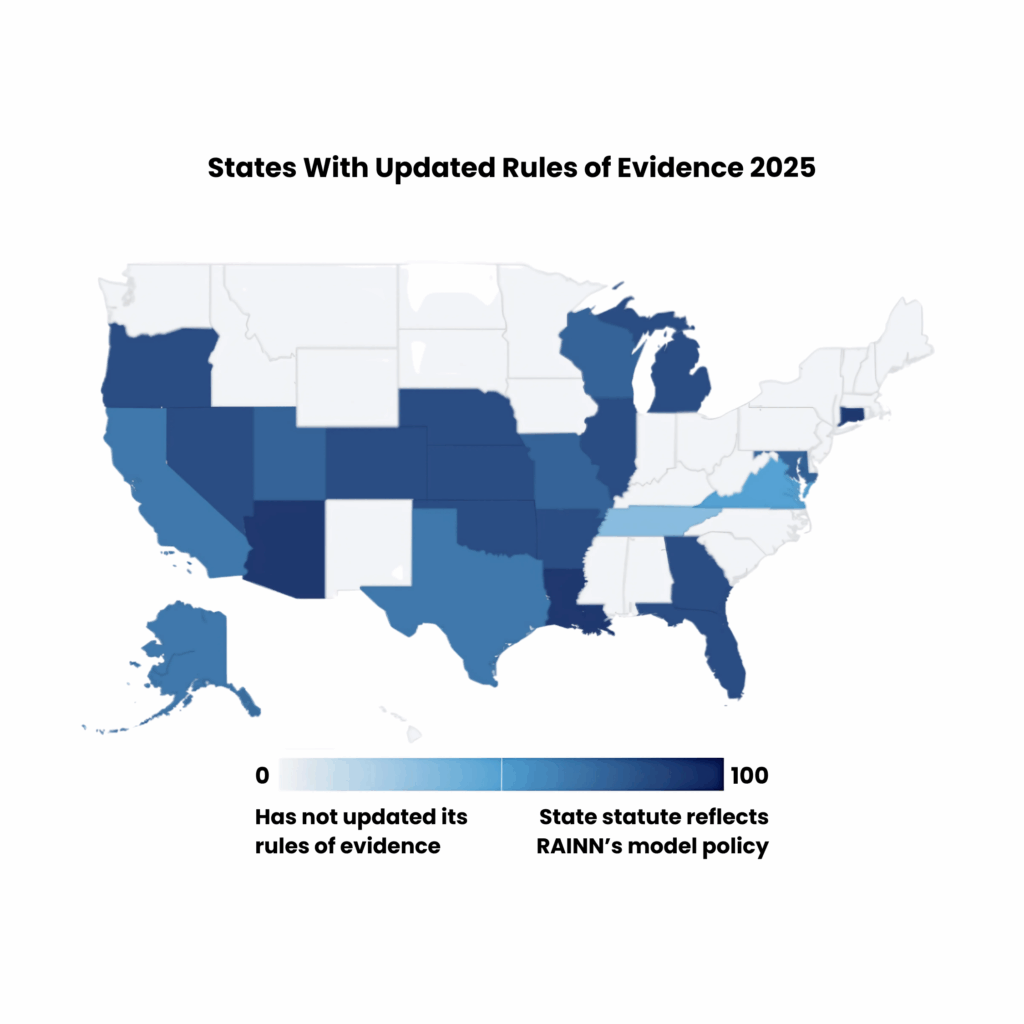
Twenty-three states have already changed their rules of evidence for cases of sex crimes involving children, while 18 of those states have changed their rules of evidence for sex crimes involving both adults and children. The Federal Rules of Evidence, which have been upheld as constitutional, allow this highly relevant evidence to be considered by juries in sexual assault trials. Survivors deserve to be heard—and juries deserve to hear them.
Courts Leave Survivors Alone in Their Fight For Justice
Sexual assault pervades our communities, but ingrained rape myths and fear often hide it. Due to the historically high underreporting of sexual assault, the true number of assaults is likely much higher. Many survivors feel alone, fear not being believed when they report, or think nothing will happen if they do. (1)
Of the reported cases, an even smaller fraction see a day in court. Approximately five to twenty forcible rapes out of 100 will be reported to law enforcement, and “0.4 to 5.4 will be prosecuted.” (2) Few cases make it to the courtroom.
Victims of sexual assault face the ordinary and appropriate burdens of proof that apply in other criminal cases; yet they often find their testimony devalued because of the same biases and inequalities that led them to be targeted for sexual assault in the first place. Perpetrators often commit sexual offenses behind closed doors, where no surveillance cameras or third-party eyewitnesses can provide corroboration.
Corroboration can and should come from other victims, who can shed light on the context of the crime. Without this evidence, survivors face undue and extreme pressure on their testimony of the crime.
Victims of other crimes do not face the myths, pervasive biases, and victim-blaming that survivors face. (3) These assumptions follow the survivor into the courtroom—if the survivor can make it that far. Even survivors whose accounts are corroborated find themselves disbelieved. (4) Furthermore, survivors of sexual assault often face forms of cross-examination and character assassination, both in and out of court, that are laced with sexism, racism, and other biases. (5)
Attrition through the justice process benefits perpetrators, who often repeat their crimes.
Approximately one-third (35.7%) of defendants in a sample of offenders identified by DNA through sexual assault kits had two or more sexual assaults linked via DNA. This is significantly higher than the 8-15% typically documented in court records. (6)
Survivors of sexual assault may not know that their assailant has a pattern of behavior, contributing to their isolation in seeking justice.
When perpetrators are brought to court, prosecutors are often hindered by rules of evidence that prevent them from presenting all the relevant evidence necessary for the jury to determine, beyond a reasonable doubt, whether the crime was committed.
Juries Are Prevented From Carrying Out Justice
Juries in your state cannot carry out justice without access to evidence of prior sexual conduct.
To illustrate the true nature of a sexual assault and counteract biases and outdated understandings of rape, prosecutors need all the evidence of the crime available to them. However, as shown in Figure 1, at least 27 states preclude prosecutors from introducing crucial evidence of the defendant’s credibility and understanding of the victim’s consent. In these states, the brave survivor enters the courtroom to give evidence without any of the perpetrator’s history to contextualize their testimony. The survivor stands alone, even when evidence shows the rapist was aware that the victim did not consent.
Lacking all context and evidence available, these juries make decisions that:
- Threaten public safety
- Fail victims
- Unfairly gauge a defendant’s guilt
Without evidence of other relevant criminal sexual conduct, the prosecution has no valid tool with which to assess the defendant’s credibility. Without this evidence, the court ignores how sexual assault is committed and perpetuated.
By allowing for the admissibility of all relevant evidence, legislation that corrects the rules of evidence helps juries carry out justice by allowing them to understand the real-life impact of serial sexual violence.
Aligning Rules of Evidence Supports Fair Jury Decisions
Sexual assault cases require that the jury understand whether the defendant knew or should have known the victim’s lack of consent.
The crucial concept of consent distinguishes sexual assault cases from other violent crimes. The jury can never convict just because the defendant committed crimes in the past, but a defendant’s past behavior can help a jury understand how to interpret the facts in a sexual offense case.
Our justice system convicts people for their actions, not their character. Changing the rules of evidence to include other relevant sexual conduct supports this by providing the jury with the full context of the crime while protecting the right to a fair trial. Changing the rules of evidence helps juries uncover the truth.
To determine the facts and allow the jury to understand the nature of consent in the case, the prosecution must prove the intent and state of mind of the defendant. Without the proposed rules of evidence, the prosecution cannot always admit evidence that would assist the jury in determining the victim’s credibility regarding what happened. With the proposed rules, however, a jury can consider prior sexual conduct of the defendant to determine the veracity of the victim and the defendant.
How It Can Play Out in Court
Let’s say the defendant (we’ll call him “John”) used to be in a relationship with a woman (we’ll call her “Sarah”). At one point in their relationship, John initiated sexual intercourse with Sarah despite her repeated protests that she didn’t want to have sex. Afterward, Sarah sent John a text telling him she was upset because he forced himself on her. Later, John hung out with his buddies and told them about the disagreement, and one of his friends told him it’s not cool to ignore someone’s refusal to have sex.
Years later, John is in court because another woman he’d been seeing (“Jane”) accused him of rape. He says it was consensual sex, and that she’s lying. John chooses not to testify, but his lawyer attacks the victim and her credibility by claiming, “This is a unique incident. How could he possibly have known that this was rape? Just because she says so? She’s lying.”
Without updated rules of evidence, the prosecutor cannot bring in the texts from the ex-girlfriend or the friend who admonished John’s behavior before.
In this example, the jury won’t know that John has been told before that his behavior is unacceptable and amounts to rape, and therefore should have known that a woman saying no to sex was rape. The jury views the incident with no context. The jury might agree with John that the victim lies.
With the updated rules of evidence, however, the prosecution can call another witness and introduce evidence to testify that John is not credible when he says there’s “no way” he could have known his behavior wasn’t okay. This evidence also backs up Jane, rebutting that she is a liar. Introducing relevant sexual conduct informs the jury on how the defendant perceived the victims’ actions and helps the jury determine the facts of the case.
RAINN’s proposal is modeled after Rule 413 of the Federal Rules of Evidence. According to FRE 413, in a criminal case in which a defendant is accused of sexual assault, the court may admit evidence that the defendant committed any other past sexual assault on any matter to which it is relevant.
Constitutional Solutions
In 1995, Congress changed the Federal Rules of Evidence to include Rule 413 (sexual assault cases) and Rule 414 (child molestation cases). These federal rules allow a court in sexual offense cases to admit a defendant’s prior relevant sexual conduct “on any matter to which it is relevant.” This includes the defendant’s propensity to commit the sexual offense. These rules created a presumption that any evidence relevant to the charged sexual offense is admissible. (7)
Federal courts held these rules were constitutional and “a prosecutor may use evidence of prior sexual assaults precisely to show that a defendant has a pattern or propensity for committing sexual assault.” (8)
The United States Supreme Court has never ruled that propensity evidence alone violates the defendant’s fundamental right to a fair trial. (9) Admitting a defendant’s prior relevant sexual conduct, even for propensity purposes, is constitutional, so long as the trial court ensures that the admitted evidence is not unfairly prejudicial. (10)
Courts recognize Congress had a legitimate purpose in admitting a defendant’s prior relevant sexual conduct. The overall objective of these rules was “enhancing effective prosecution for sexual assaults.” (11) Congress believed that admitting this evidence would assist juries in assessing credibility. Congress knew that crimes of sexual violence “frequently involved victim-witnesses who are traumatized and unable to effectively testify.” (12)
As Representative Bob Dole stated in support of these rules:
“[S]exual assault cases, where adults are the victims, often turn on difficult credibility determinations.
“Alleged consent by the victim is rarely an issue in prosecutions for other violent crimes—the accused mugger does not claim that the victim freely handed over his wallet as a gift—but the defendant in a rape case often contends that the victim engaged in consensual sex and then falsely accused him.
“Knowledge that the defendant has committed rapes on other occasions is frequently critical in assessing the relative plausibility of these claims and accurately deciding cases that would otherwise become unresolvable swearing matches.” (13)
Congress, courts, and even critics of these rules acknowledge that admitting relevant sexual conduct of the defendant is important in sexual offense cases, where too often the focus is on the victim instead of the defendant. (14)
- A defendant’s prior relevant sexual conduct can corroborate the victim’s testimony.
- Evidence of relevant sexual conduct by the defendant reduces the impact of biases and rape myths on jurors.
- “Corroboratory information about the defendant limits the prejudice to the victim that often results from jurors’ tendencies to blame victims in acquaintance rape cases.” (15)
An additional legitimate legislative purpose of Rule 413 is that it “encourages rape reporting and increased conviction rates by directing the jury’s attention to the defendant.” (16)
When the jury is considering the credibility of the witnesses, a defendant’s prior relevant sexual conduct is important in assessing the defendant’s credibility. During trial, victims are frequently ridiculed for their actions during a sexual offense and made to appear as though their behavior is unique or unusual while the defendant’s behavior is “normal.”
If the victim’s credibility may be attacked, then evidence of the defendant’s credibility should also be considered.
Admitting a defendant’s prior relevant sexual conduct presents the jury with the whole picture, which can impeach the defendant’s credibility. This important evidence should not be introduced only if the defendant chooses to testify. “It is no great stretch to permit the [impeachment] evidence to be introduced in the case-in-chief when defense counsel is making the argument.” (17)
Every federal court and nearly every state court ruling on the constitutionality of a rule admitting a defendant’s prior relevant sexual conduct has held that the rule is consistent with a defendant’s right to a fair trial. Courts recognize “the unique nature of sexual assault crimes”, the historical admission of propensity evidence in sexual assault cases, and the protections provided by other rules of evidence as reasons for admitting this important evidence.

For Legislators: Example Legislation
RAINN’s policy memos and issue briefs help lawmakers draft bills that promote justice for survivors and hold perpetrators accountable.
Work With Us
We recognize that each state’s code is unique and complicated. RAINN’s policy team can work hand in hand with lawmakers and their staff to tailor these recommendations to each state’s specific needs.
Contact RAINN’s Policy Team
RAINN works with lawmakers across the country to advance bipartisan legislation that prevents sexual violence, improves justice, and holds perpetrators accountable.
NOTES & CITATIONS
(1) Murphy-Oikonen, J., Chambers, L., Miller, A., & McQueen, K. (2022). Sexual Assault Case Attrition: The Voices of Survivors. Sage Open, 12(4). https://doi.org/10.1177/21582440221144612 Opens in a new tab
(2) Lonsway, K. A., & Archambault, J. (2012). The “Justice Gap” for Sexual Assault Cases: Future Directions for Research and Reform. Violence Against Women, 18(2), 145-168. https://doi.org/10.1177/1077801212440017 Opens in a new tab
(3) https://www.ourresilience.org/what-you-need-to-know/myths-and-facts/ Opens in a new tab
(4) Murphy-Oikonen J, McQueen K, Miller A, Chambers L, Hiebert A. Unfounded Sexual Assault: Women’s Experiences of Not Being Believed by the Police. J Interpers Violence. 2022 Jun;37(11-12):NP8916-NP8940. doi: 10.1177/0886260520978190. Epub 2020 Dec 11. PMID: 33305675; PMCID: PMC9136376.
(5) Huhtanen, H. (2022). Gender Bias in Sexual Assault Response and Investigation. Part 1: Implicit Gender Bias. End Violence Against Women International. https://evawintl.org/wp-content/uploads/TB-Gender-Bias-1-4-Combined-1.pdf Opens in a new tab Monahan, Jerald, and Sheila Polk. “The Effect of Cultural Bias on the Investigation and Prosecution of Sexual Assault.” Policechiefmagazine.org, Police Chief Magazine, 2021, www.policechiefmagazine.org/the-effect-of-cultural-bias-on-the-investigation/ Opens in a new tab.
(6) Campbell, R., Feeney, H., Goodman-Williams, R., Sharma, D. B., & Pierce, S. J. (2020). Connecting the dots: Identifying suspected serial sexual offenders through forensic DNA evidence. Psychology of Violence, 10(3), 255–267. https://doi.org/10.1037/vio0000243 Opens in a new tab
(7) Concerns that this evidence would prolong cases or require additional evidence are addressed by existing rules of evidence that allow a judge to exclude evidence that would cause undue delay, waste time, or present cumulative evidence.
(8) United States v. Schaffer, 851 F.3d 166, 178 (2d Cir. 2017)
(9) U.S. v. Enjady, 134 F.3d 1427, 1431 (10th Cir.1998)
(10) United States v. Schaffer, 851 F.3d 166, 180 (2d Cir. 2017).
(11) U.S. v. Enjady, 134 F.3d 1427, 1434 (10th Cir.1998)
(12) Id.
(13) 140 Cong. Rec. S129901–01, S12990 (R. Dole, Sept. 20, 1994) U.S. v. Enjady, 134 F.3d 1427, 1431 (10th Cir.1998)(quoting).
(14) U.S. v. Enjady, 134 F.3d 1427, 1432 (10th Cir.1998)(quoting M. Sheft, Federal Rule of Evidence 413: A Dangerous New Frontier, 33 Am.Crim. L.Rev. 57, 69-70 (1995))
(15) Id.
(16) Id.
(17) U.S. v. Enjady, 134 F.3d 1427, 1433 (10th Cir.1998)
Last updated: July 26, 2026