Policy & Justice
Involuntary Pelvic Exams: Protect Patients With Informed Consent
RAINN urges state lawmakers to prohibit medical students from practicing intimate exams without the patient’s prior written informed consent.
A patient drifts into anesthesia for their shoulder surgery. While they’re unconscious, a medical student is brought in to practice a pelvic exam on the sedated patient. The student hesitates—they don’t know the patient; they haven’t discussed the exam—but the pressures of their education win out, and they conduct the medically unnecessary exam. Later, when the patient wakes up, their shoulder hurts—but their genitals are also sore. There’s no record of an exam; they never knew someone would touch them in an intimate place while they were under anesthesia. The patient leaves, feeling violated and reconsidering future medical care.
This is based on the real experiences of patients and medical students who have testified nationwide on legislation requiring informed consent prior to practicing pelvic exams. Over half the nation now requires informed consent from patients in these settings, protecting students and promoting best practices.
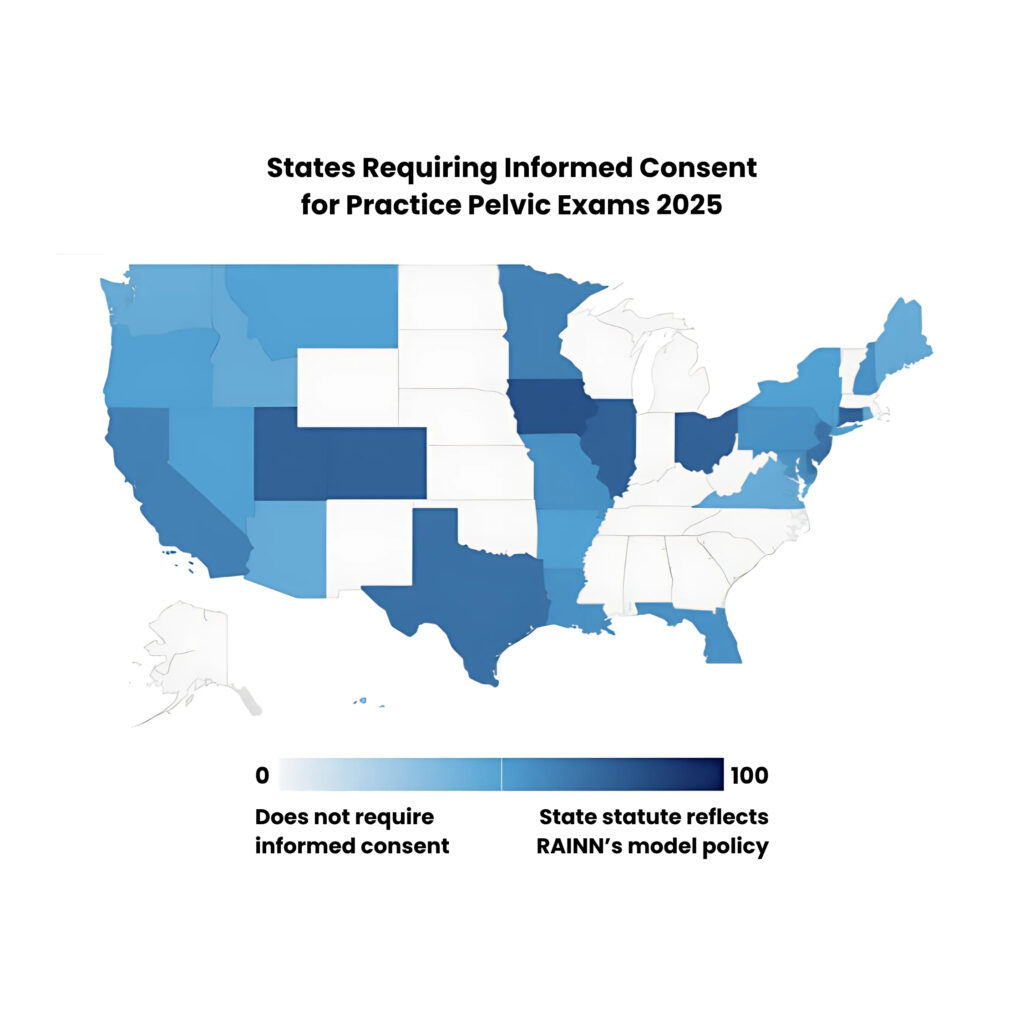
At RAINN, we work to ensure no one wakes up from an unrelated procedure feeling violated, and no survivors avoid necessary medical care due to fear of a non-consensual exam.
State lawmakers can protect survivors by ensuring their state laws require informed consent before invasive practice exams and hold those who fail to adhere to this best practice accountable.
Involuntary Exams: A Little-Known (Yet Widely Practiced) Problem
A pelvic exam is a medical procedure in which a healthcare provider examines a person’s rectum and/or reproductive organs, including the vagina, cervix, uterus, and ovaries. This examination is typically conducted for various medical reasons, such as routine screenings, gynecological issues, or during pregnancy.
Informed consent is a fundamental principle in medical ethics, and it involves providing patients with information about a proposed medical procedure, including its purpose, potential risks and benefits, and alternative options so that the patient can make an informed decision about whether to proceed.
Involuntary pelvic exams refer to medically unnecessary pelvic examinations that are performed without the explicit and informed consent of the patient.
Students initially learn the pelvic examination skills on mannequins or nonpatient volunteers. In an operating room, students can perform this exam while a patient is under anesthesia. Nearly half of U.S. states allow physicians and medical residents to perform pelvic exams on unconscious patients during unrelated operations without receiving their informed consent. Such an exam amounts to sexual assault on the patient since it has no medical benefit and is performed without their awareness or permission.
Potential harm from this unauthorized exam includes:
- Medical students feeling anxiety and guilt
- Patients feeling violated
- Survivors of sexual assault experiencing post-traumatic stress disorder
- Loss of trust between patients and their healthcare providers.
While testifying to a bill requiring informed consent in Ohio, one medical student said:
“Our oath as medical students and physicians is to do no harm to the patient. Performing unauthorized pelvic exams on anesthetized patients for the sole purpose of medical student education violates this principle and may cause unacceptable psychological harm to patients. No learning opportunity is worth sacrificing a patient’s well-being.”
States have the opportunity to significantly shape the way consent is prioritized for patients in a healthcare setting. Requiring informed consent for practice pelvic exams will improve the quality of every patient’s experience with the medical field and maintain a person’s agency over their body during medical interactions.
Especially for survivors of sexual assault, ensuring that medical interactions are transparent and safe protects against retraumatization and fear-based avoidance of needed healthcare.
Transparency cannot occur without both the comfort and consent of patients and medical trainees. Requiring explicit consent for all patients will improve the physician-patient relationship and a patient’s psychological and emotional well-being.
Protecting the Patient-Physician Relationship
The physician-patient relationship is built on a foundation of trust. RAINN has heard from many survivors regarding unauthorized pelvic exams on patients, despite many medical institutions publicly stating they do not allow the practice. It has long been standard practice not to obtain the patient’s consent before conducting the examination.
Non-Consensual Practice Exams are Normalized & Common
Many medical students feel as if they cannot opt out of non-consensual practice exams without jeopardizing their grades and careers, since these exams are conducted under the supervision of residents and attending physicians who write their evaluations. In a recent survey, 90% of American medical students stated that they had performed a medical exam on an anesthetized patient (1); 61% of medical students who had performed a pelvic exam on an anesthetized patient reported doing so without the patient’s explicit consent (2). Many of these students were in schools where involuntary pelvic exams were outlawed, making it likely that, in states that still allow the practice, the percentages are even higher.
A later study at the University of Oklahoma found that a large majority of medical students there had performed pelvic exams on gynecological surgery patients and that nearly 75% of these women had not consented to the exam (3). Legislation and outside oversight are necessary to safeguard patients’ rights.
Only 19% of patients reported being aware that medical students might perform pelvic examinations on them during surgery, according to one 2010 study (4). Furthermore, 72% of women expect to be asked for permission before an exam under anesthesia (EUA), and 62% say they would consent if they were asked (5).
What’s Being Done to Protect Patients & Medical Students
In recent years, lawmakers, medical students, survivors, and advocates have raised awareness for patients’ right to be informed and give consent for all medical procedures, including pelvic exams.
The American College of Obstetricians and Gynecologists (ACOG) supports explicit informed consent policies.
As of now, at least 26 states have passed laws banning unauthorized pelvic exams to ensure transparency and consent is prioritized for all patients, including:
- Arizona
- Arkansas
- California
- Colorado
- Connecticut
- Delaware
- Florida
- Idaho
- Illinois
- Maine
- Maryland
- New York
- Oregon
- Pennsylvania
- Rhode Island
- Virginia
A Wisconsin teacher who was given an unauthorized pelvic exam stated that “a woman unconscious on an operating table is at her most vulnerable. If anyone is going to be penetrating… that needs to be disclosed.” (6)
“They might not be performing a sexual act, but the result from the patient’s end, from my end, was a feeling of sexual violation.”
– Anonymous, survivor (7)
Creating a universally employed consent process paves the way for prioritizing every patient’s body autonomy and awareness when it comes to pelvic exams, such as prostate, urogenital, and rectal exams.
Informed Consent: The Law & HHS Guidance
The U.S. Department of Health and Human Services (HHS) issued a memorandum in 2024 addressing involuntary pelvic exams. No federal law exists criminalizing the practice, and regulation of the medical field is left primarily to the states, which means state legislation is needed to protect survivors and ensure informed consent practice. In fact, in disseminating the rule, HHS commended states for passing legislation on this issue.
The HHS guidance reinforced informed consent obligations for medical providers, the consequence of which may be loss of funding for the institution itself. If anything, the informed consent obligation sets a standard that state legislatures need to meet or align with.
However, HHS guidance applies only in the context of funding under Medicare or Medicaid services. HHS cannot declare involuntary pelvic exams for what they are, which is a crime of sexual assault.
State laws can and should mandate informed consent both under physician licensing and oversight, as well as through criminal punishment.
By taking these actions, states can provide protection and support for victims that HHS guidance cannot provide (for example, victims can’t get a criminal protective order through a court case). Nothing in the current HHS rules or guidance requires the loss of a medical license or imposes punishment if a physician were found to have engaged in involuntary pelvic exams. (Most criminal convictions would impact medical licensure.) Further, current HHS rules and guidance do not provide a voice for victims, because there is no mechanism for investigation by medical licensing organizations or law enforcement. This may result in decreased reporting by survivors.
The HHS guidance reaffirms the requirement for informed consent in these situations as best practice. It carries no legal consequences nor addresses the issue entirely. It sets an expectation for health professionals to follow without truly enforcing the expectation—especially when medical facilities already assure that their policies cover this issue.
RAINN urges legislators addressing the issue of involuntary pelvic exams to work with hospitals and medical professionals to ensure that informed consent becomes every state’s policy both as a best practice and through legal requirements.

For Legislators: Example Legislation
RAINN’s policy memos and issue briefs help lawmakers draft bills that promote justice for survivors and hold perpetrators accountable.
Work With Us
We recognize that each state’s code is unique and complicated. RAINN’s policy team can work hand in hand with lawmakers and their staff to tailor these recommendations to each state’s specific needs.

Contact RAINN’s Policy Team
RAINN works with lawmakers across the country to advance bipartisan legislation that prevents sexual violence, improves justice, and holds perpetrators accountable.
NOTES & CITATIONS
(1) Coleman, E. (2021, April 13). States move to protect anesthetized women from non-consensual pelvic exams. Route Fifty.
(2) Dr. Tsai, Jennifer. (2021, November 29). Medical students regularly practice pelvic exams on unconscious patients. Should they? ELLE.
(3) Coleman, E. (2021, April 13). States move to protect anesthetized women from non-consensual pelvic exams. Route Fifty.
(4) Dr. Tsai, Jennifer. (2021, November 29). Medical students regularly practice pelvic exams on unconscious patients. Should they? ELLE.
(5) Ibid.
(6) Goldberg, E. (2020, February 17). She didn’t want a pelvic exam. She received one anyway. The New York Times. https://www.nytimes.com/2020/02/17/health/pelvic-medical-exam-unconscious.html?referringSource=articleShare Opens in a new tab
(7) Goddard, A. J. (Director). (2025). At Your Cervix [Video]. https://www.atyourcervixmovie.com/home/ Opens in a new tab
Last updated: July 26, 2026